
Key Takeaway: IBS isn’t just about food sensitivity. Unconscious stress and overstimulated adrenals keep your digestive system locked in reactive mode.
In this post, you’ll see why removing extra stressors and retraining your brain rewires the gut-brain axis. Targeting the root causes of Irritabel Bowel Syndrome is the basis of my IBS Core Reset Program.
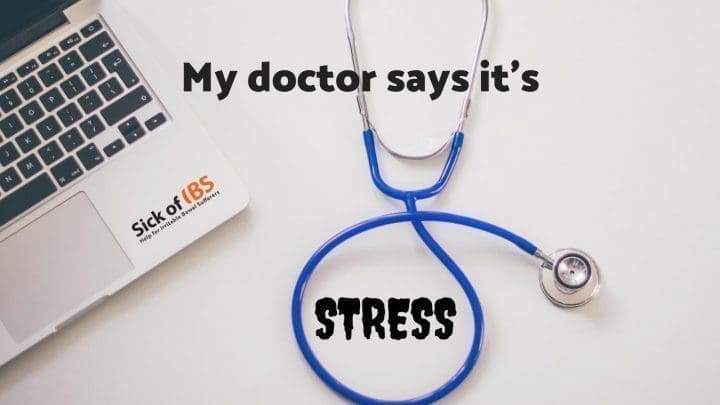
One of the most frustrating things we can hear from a doctor about our IBS is “It’s just stress…
Hearing that your Irritable Bowel Syndrome comes from stress isn’t helpful. It doesn’t tell you what to do about that stress or how to recover.
For me stress was something that couldn’t be changed. I was stuck with it. So this meant I was also stuck with IBS.
But I have since fully recovered from my IBS. For me stress did play a large part, leaving me feeling oversensitive and over-reactive. And I came to see the role of stress in creating physical pain.
IBS and stress

Do you feel overly sensitive and reactive to everything?
Everything from food, to people and situations?
You have probably already heard of the vagus nerve. It is the major nerve (the 10th cranial nerve) that runs from your brain, down to the neck and communicates with the major organs in the body.
It has two main ways of functioning:
Its normal state is where the famous parasympathetic nervous system supports your body: You breathe well, digest well and your kidneys, liver and intestines are all working towards health.
The second state of functioning, the sympathetic nervous system, which takes over every time we feel stress and have a reaction to fear. The body prepares the famous fight, fight or freeze or fawn reaction. Our bodies are working towards survival.
Depending on the type of reaction that is triggered, you can find yourself experiencing diarrhoea, constipation, bloating, headaches, and fatigue: IBS related to stress.
When the perceived danger has passed the body should naturally recover and return to a state of balance (homeostasis).
However if the fight, flight or freeze mechanism becomes a way we become programmed to live every day, we can disturb our natural balance. This is where the adrenal glands stay on alert all the time, creating adrenal fatigue.
The sympathetic nervous system is stimulated every time we feel unsafe – consciously, or unconsciously.
Our minds can have a hard time making the difference between day-to-day worries and real danger. Your mind may, for example, sense danger every time you see your boss, a person you don’t like, or feel under time pressure. Or when you watch the news.
I reached a point of continual stress. I felt very tired or anxious and jittery all the time. Oversensitive and over-reactive. With no clue as to why.
How to do something about IBS related to stress
If IBS and stress are the bane of your life, this is how you can move forward:
1) Allow yourself to really unwind
Unwinding allows your body to move out of the stress response, even temporarily, and feel safety again.
Over time, unwinding can help increase your nervous system’s capacity to handle stress better.
Many of the activities I have mentioned in previous articles to slow down and listen, are also good for alowing yourself to unwind.
These are activities like deep breathing, singing, meditation, light regular exercise, regularly getting out into the sun, listening to music, massage, doing something for fun, spending time with pets, positive social interactions, EFT.

These activities have the added benefit of allowing you to get clearer about your IBS triggers.
If your body is firing off all day long, it is hard to see the wood for the trees.
If unwinding becomes a regular habit, you will loosen up IBS and stress, and your IBS triggers will become clearer to you.
2) Avoid negative stimulation
You can’t avoid all stressful situations. You wouldn’t go out of the house! But you can choose to reduce some habits that can create extra stress and IBS:
Watching the news

Watching the news is stress with a plug!
The media have that way of reporting that awful thing that happened on the other side of the planet, in a way that fires off a reaction as if we were living it here and now.
And this in turn makes your system feel unsafe.
I stopped watching the news. And started looking for the good things that were happening around me instead.
Watching the news and “staying informed” was a habit. It felt really strange not to at first. But what a relief that was.
The really important stuff you get to hear about anyway. So why force yourself to listen to an hour of gloom and doom every day?
Why not use the time to look after yourself – and do something enjoyable or unwind instead.
Kick that coffee

Another one to watch out for is coffee. I used to drink about 4 or 5 cups per day. It’s just stress in a cup. Something that can really amplify IBS related stress.
That was a hard habit to crack. But I finally managed it.
There is no point on the one hand trying to become less reactive while taking any kind of stimulant.
If you really do need a coffee to get your bowels moving in the morning, just have one cup of decaf. A study shows that decaf has the same effect on bowel movements as real coffee.
3) Learn to change your reactions to stress
The third part to changing how stress affects you is this.
You can’t necessarily change events – but you can alter your reaction to them.
If you change how you react to IBS related stress, your symptoms can improve.
However this is unlikely to happen all by itself.
Stress is a reaction, a label given by your mind to specific situations you have learned to fear. It is for the most part unconscious and automatic. And it is often a powerful IBS trigger.
So the solution lies in becoming aware of those automatic reactions setting off your IBS symptoms. And learning to experience them differently.
This is where I started looking into the research into neuroplasticity and the possibility of reprogramming and interrupting our reactions to specific situations – and in turn interrupting IBS symptoms.
There are several ways of doing this, and it takes a little time and commitment to see results. But for me this was key to recovering from IBS. It is what gets my coaching clients tangible results that last.
When you start clearly seeing your triggers, you can start to understand why they show up as perceived danger. And YOU can take control.

Alison Adenis | IBS Interrupt™ Coach
Important Note: My work focuses on trigger identification and release based on my personal experience, training, and client work.
This content is for informational and educational purposes only.
I am not a doctor. For diagnosis and clinical treatment, always consult your medical professional.